Things to Do in Glasgow
Scotland's biggest city is also its most misread. Here is what is actually there, and what is currently closed.

Short answer
Glasgow's best attractions are free: Kelvingrove and the Riverside Museum each took over 1.2 million visits in 2025, and Glasgow Cathedral is the only mainland Scottish cathedral to come through the Reformation with its roof on. Two days covers the city. The subway, opened in 1896, is the third oldest in the world.
Two Glasgow museums each pulled over 1.2 million visits in 2025. Kelvingrove Art Gallery and Museum took 1,219,831, up 3% on the year. The Riverside Museum took 1,212,151. Neither charges admission. Across the city, Glasgow's museums together recorded around 3.7 million visits, which is a lot of footfall for a city that most international itineraries still treat as an airport with a train station attached.
That gap between what Glasgow is and what visitors assume it is runs through everything here. Edinburgh is a set piece and knows it. Glasgow is a working Victorian merchant and shipbuilding city that got rich, got poor, and spent the last thirty years turning its industrial carcass into galleries and venues. The result is less immediately photogenic and considerably more interesting on the third day.
The free museums, and why they are this good
Glasgow's civic museums are free because the city decided a century and a half ago that they should be, and that decision is why a shipbuilding town owns a Salvador Dalí and one of the best arms and armour collections in Europe.
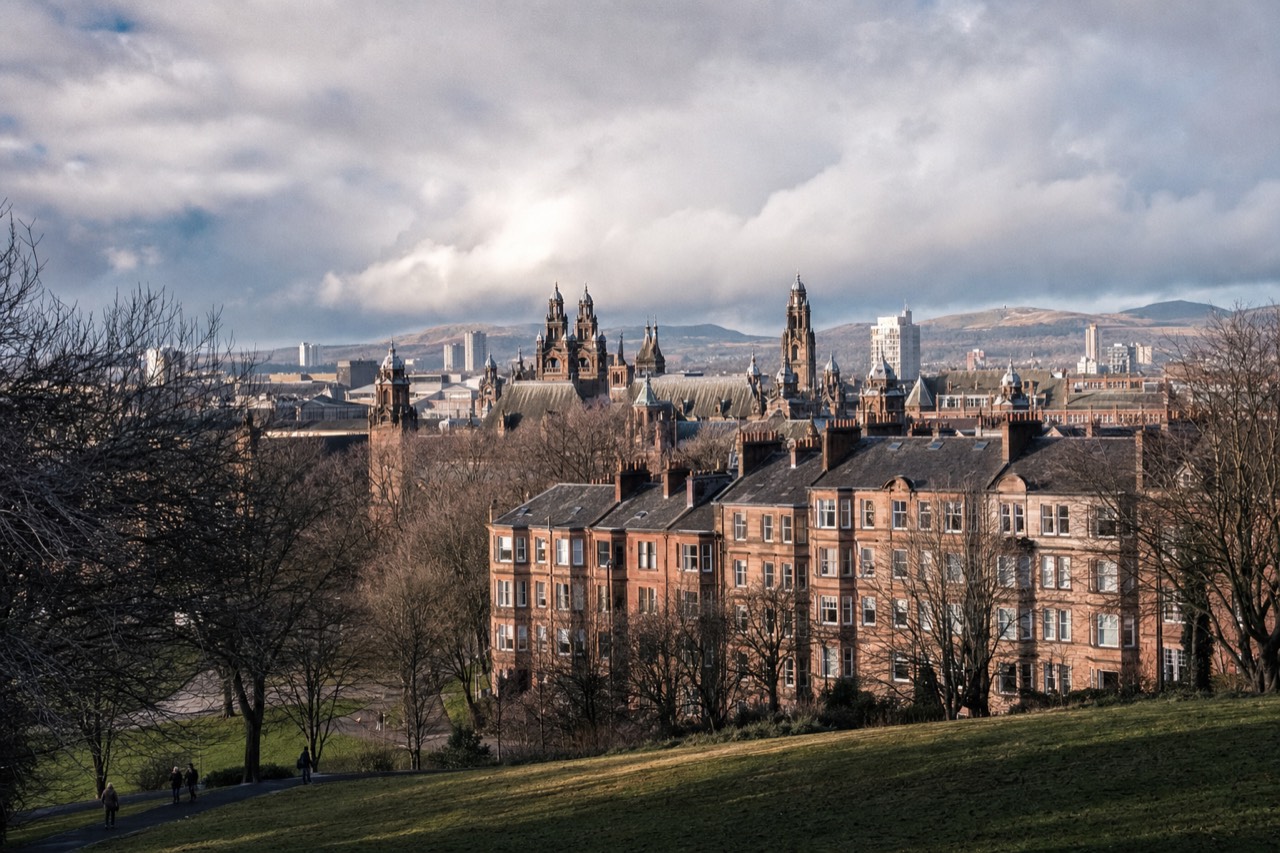
Kelvingrove is the flagship: a red sandstone pile at the west end with 22 galleries covering everything from Egyptian antiquities to Glasgow Boys paintings, an organ recital most days, and a Spitfire hanging over the hall. Two hours is the minimum and it will not feel like enough.
The Riverside Museum is the other one, a Zaha Hadid building on the Clyde holding the city's transport collection: locomotives, trams, a reconstructed 1930s street, and the tall ship Glenlee moored outside for free. It reads as a museum for children and is not. The Glasgow subway carriages on display are the same design that opened in 1896.
The Burrell Collection in Pollok Country Park is the third, reopened after a long refurbishment and set in woodland three miles south of the centre. It is the personal collection of a single shipping magnate and it is strange in the best way.
| Attraction | 2025 visits | Admission | Time to allow |
|---|---|---|---|
| Kelvingrove Art Gallery and Museum | 1,219,831 | Free | 2 to 3 hours |
| Riverside Museum and the Glenlee | 1,212,151 | Free | 2 hours |
| Burrell Collection, Pollok Country Park | Part of the 3.7 million city total | Free | 2 hours plus the park |
| Glasgow Cathedral and the Necropolis | Part of the 3.7 million city total | Free, donation welcome | 1 to 2 hours |
| Gallery of Modern Art, Royal Exchange Square | Part of the 3.7 million city total | Free | 1 hour |
Only two Glasgow attractions appeared in the published national top rankings for 2025, at 26th and 28th in the UK. That understates the city, because the free-entry sites that did not make the cut still collectively account for millions of visits.
Glasgow Cathedral and the Necropolis
The cathedral is the oldest building in Glasgow and the single most historically significant thing in the city. It is also the only cathedral on the Scottish mainland to have survived the Reformation of 1560 without being un-roofed, which makes it a genuine medieval interior rather than a ruin or a rebuild. St Magnus in Orkney is the only other Scottish cathedral in that category.
Go down into the lower church, which is where the tomb of St Mungo sits and where the stone vaulting is at its best. Entry is free and the site is cared for by Historic Environment Scotland, which looks after more than 300 properties nationally on seasonal opening hours. Winter closing is earlier than summer, and the Scottish Outdoor Access Code that governs walking rights across Scottish land does not extend to buildings, so the cathedral runs on its own posted hours rather than being open at will.
Behind it, across a small bridge, is the Necropolis: a Victorian hillside cemetery of monuments to the merchants who built the city, with the best free view back over the cathedral and the East End. It takes twenty minutes and almost nobody who is not already up there knows it exists.
Mackintosh, and the honest state of the Mackintosh Building
Charles Rennie Mackintosh is the reason a lot of people put Glasgow on a list, so this needs saying plainly rather than buried in a footnote.
The Glasgow School of Art's Mackintosh Building, his masterpiece and the building most guides tell you to see, burned in 2014 and again in 2018. It has not been rebuilt. In July 2026 the school's board stated that the roughly £265 million cost of full reinstatement is unaffordable for the institution alone, and said it would seek external partners. The current plan is to remove the external scaffolding from summer 2027 and replace it with an internal retention system that stabilises and exposes the shell. You cannot go inside it, and you will not be able to for years.
That is not a reason to skip Mackintosh in Glasgow. It is a reason to plan around the shell rather than turn up expecting a tour.
What you can still see: the Mackintosh at the Willow tea rooms on Sauchiehall Street, restored to his design; the Mackintosh House at the Hunterian, which reassembles the interiors of his own home; Scotland Street School; and the Glasgow Art Club interiors. Between them they carry the style better than a single visit to one building would.
| Mackintosh site | Status | Cost |
|---|---|---|
| Glasgow School of Art, Mackintosh Building | Fire-damaged shell, closed, reinstatement unfunded | Exterior viewing only |
| Mackintosh at the Willow, Sauchiehall Street | Open, restored tea rooms | Tea room prices; exhibition ticketed |
| The Mackintosh House, Hunterian | Open | Ticketed, low cost |
| Scotland Street School Museum | Open on limited days, check ahead | Free |
| House for an Art Lover, Bellahouston Park | Open, built to his 1901 competition drawings | Ticketed |
Music, and why the UNESCO title is not marketing
Glasgow was named the UK's first UNESCO City of Music in August 2008, and only the third in the world at the time. The label sounds like tourism copy until you look at the venue density: King Tut's, the Barrowland Ballroom, the Hydro, the Royal Concert Hall, St Luke's, plus a long tail of pub back rooms that put on bands most nights of the week.
The Barrowland in particular is worth a ticket to almost anything. It is a sprung-floor 1930s ballroom in the East End with a neon sign that is a landmark in its own right, and touring musicians name it as a favourite room with unusual consistency.
Practically: check what is on before you fix your dates, because a Barrowland night is a better Glasgow evening than any restaurant. Gigs are ticketed separately from anything on this site and sell out fast, and VisitScotland keeps a running events calendar that is the quickest way to see what falls inside your window.
How long to stay
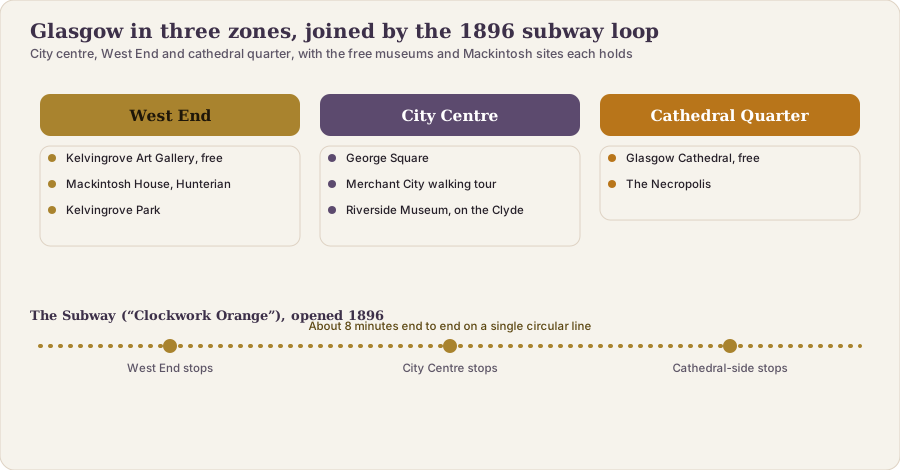
Glasgow is bigger than Edinburgh and more spread out, but its sights cluster into three zones: the city centre and Merchant City, the West End around Kelvingrove and the university, and the cathedral and East End. Each is a half day.
| Days | What fits |
|---|---|
| 1 | Cathedral and Necropolis in the morning, city centre and George Square, Kelvingrove in the afternoon |
| 2 | Add the Riverside Museum and the Clyde, the West End and the university, a gig or a good dinner |
| 3 | Add the Burrell and Pollok Park, a Mackintosh site or two, and time in the Merchant City |
| 4 or more | Use Glasgow as a base: Loch Lomond, Stirling, or Edinburgh in under an hour by train |
The comparison people actually want is Glasgow against Edinburgh, so here it is without diplomacy.
| Glasgow | Edinburgh | |
|---|---|---|
| First impression | Grid of Victorian sandstone, industrial river | Medieval ridge and Georgian grid, castle on a rock |
| Museums | More of them, nearly all free | Fewer, the national ones free and excellent |
| Walkability | Larger, flatter, subway helps | Compact, steep, walkable end to end |
| Nightlife and live music | Considerably stronger | Strong in August, quieter otherwise |
| Peak-season pressure | Manageable year-round | Extreme in August |
| Best for | A second or third Scottish city, or anyone here for music | A first trip, and the postcard version |
Doing both is the obvious move given the train takes under an hour. Our Edinburgh planning guide covers the other end of that line.
The dear green place
Glasgow's name is usually translated from its Brittonic and Gaelic roots as the dear green place, and the city keeps up the claim with an unusual density of public parks for a place its size. Glasgow Green, along the north bank of the Clyde east of the centre, is the oldest of them and the one with the most history attached: it is where the city's washing was dried, where political rallies were held for two centuries, and where the People's Palace and its winter gardens sit.
Kelvingrove Park is the one most visitors use, because the art gallery and the university tower are both on its edges and the walk between them through the park is better than the walk around it. Pollok Country Park, three miles south, holds the Burrell Collection, a working Highland cattle fold and a stretch of woodland that does not feel like a city at all.
The Clyde walkway is the fourth. Following the river west from the centre takes you past the Science Centre, the Armadillo and the Hydro to the Riverside Museum, and it is the clearest way to read what happened to Glasgow: shipyard cranes still standing over ground that now holds concert venues.
None of this is a headline attraction and that is the point. An hour in Kelvingrove Park between two museums is what turns a checklist visit into an actual sense of the city, and it costs nothing.
Getting around
The Glasgow Subway opened on 14 December 1896, which makes it the third oldest underground metro system in the world after London and Budapest. It is a single circular line, it is small, and locals call it the Clockwork Orange. For a visitor its main use is the hop between the city centre and the West End, which it does in about eight minutes.
Walking handles the city centre and the Merchant City comfortably. The cathedral is a fifteen-minute walk east of George Square. The Riverside Museum is far enough west along the Clyde that most people take a bus or the sightseeing bus rather than walk it.
The sightseeing bus is a genuine convenience here in a way it is not in Edinburgh, because Glasgow's attractions are further apart. The hop-on hop-off sightseeing ticket carries 4.5 stars across 2,014 reviews. The guided city centre walking tour is the better choice for understanding the place, taking in George Square, Glasgow Cathedral and the Merchant City with a local guide at 4.8 stars across 1,532 reviews, and starting around $19.44.
For the full side-by-side of both, including how they overlap and which suits a short stopover, see our Glasgow day tours guide.
Getting to Glasgow and moving on is straightforward, with one quirk: the airport has no rail link, so the connection into town is a bus rather than a train.
| Journey | Rough time | Notes |
|---|---|---|
| Airport to city centre by bus | About 20 minutes | No rail connection; the express bus is the standard route |
| Glasgow to Edinburgh by train | Under an hour | Queen Street to Waverley, several an hour |
| Glasgow to Balloch, for Loch Lomond | About 45 minutes | Direct train; no tour needed for a half day |
| Glasgow to Oban by train | About 3 hours | The West Highland Line, one of the great rail journeys |
| Glasgow to Fort William by train | About 3 hours 45 | Same line, continuing north through Rannoch Moor |
Those last two rows are the reason some visitors base themselves here rather than in Edinburgh. The West Highland Line leaves from Glasgow, and it is a genuine attraction in its own right rather than just transport.
Getting out of the city
Glasgow's own trips are limited, and pretending otherwise would not help anyone. Most of Scotland's organised day tours and multi-day packages depart from Edinburgh, which is under an hour away by train and therefore a viable start point even if you are sleeping in Glasgow.
The exception is the eight-day Scottish Dream package, which genuinely begins in Glasgow with a first day covering Kelvingrove, Glasgow Cathedral and the River Clyde before heading north through Loch Lomond and Inveraray. If you want a full package that starts where you are staying, this eight-day Glasgow departure is the one that does.
For day trips, the Stirling Castle, whisky and Kelpies run shown above is the strongest single-day option in the central belt: a real castle, a working distillery visit, and Andy Scott's thirty-metre horse-head sculptures at Falkirk. Be clear on one thing before booking, because it matters: that tour departs from Edinburgh, not Glasgow. If you are based here you would take an early train through, which is easy but needs planning into the day.
Loch Lomond is the genuinely close one, about forty minutes north by road and reachable on public transport to Balloch. It is the obvious half-day escape and needs no tour at all.
If you want something longer on a smaller budget, the three-day hostel-style loop is the cheapest way to reach Skye and Loch Ness with a guide, though it also starts in Edinburgh and sleeps in shared dorms. Read the format honestly before booking it: no meals, no private rooms, medium-intensity pace.
Our Scotland package cost breakdown shows what each tier includes, and our comparison of coach touring against self-drive is the piece to read if you are deciding whether to hire a car at all. If Loch Ness itself is the draw rather than the drive, our Loch Ness format comparison is more specific.
When to come
Glasgow's weather is wetter than Edinburgh's and its crowds are gentler. That combination means the seasonal calculation here is almost the opposite of the capital's: you are choosing on daylight and events rather than on avoiding pressure.
| When | What it is like | Worth knowing |
|---|---|---|
| January to March | Cold, wet, dark by four | Cheapest beds; the free museums are the point |
| April to May | Longer evenings, showery | Good value, festivals starting |
| June to August | Long light, warmest, still showery | Busiest but nothing like Edinburgh in August |
| September to October | Mild, settled spells, autumn in the parks | Arguably the best month here |
| November to December | Dark, festive, indoor city | Christmas markets and the gig calendar peaks |
There is no month when Glasgow is unpleasant, because most of what you came for has a roof. That is a real advantage over the rest of Scotland and it is why a Glasgow leg is a sensible hedge in a wet forecast. For the wider country-level view, our answer on when to avoid visiting Scotland covers the months that genuinely cause problems.
Questions people ask about Glasgow
Is Glasgow worth visiting, or should you just do Edinburgh?
Both, if you have four days or more. Edinburgh is the more immediately spectacular city and the easier first visit. Glasgow has more museums, all free, a stronger live-music scene and better food for the money. The train between them takes under an hour, so treating it as a choice is usually a mistake.
Can you visit the Glasgow School of Art?
Not the Mackintosh Building. It burned in 2014 and again in 2018 and remains a shell, with full reinstatement priced at around £265 million and currently unfunded. You can see the exterior. For Mackintosh interiors, the Mackintosh House at the Hunterian, Mackintosh at the Willow and House for an Art Lover are all open.
How many days do you need in Glasgow?
Two full days covers the cathedral, the city centre, Kelvingrove and the Riverside Museum without rushing. A third day adds the Burrell Collection, Pollok Park and the Mackintosh sites. Anything beyond that is better spent using Glasgow as a base for Loch Lomond or a train through to Edinburgh.
Are Glasgow's museums really free?
Yes. Kelvingrove, the Riverside Museum, the Burrell Collection, the Gallery of Modern Art and the People's Palace all have free general admission, funded as civic institutions. Special exhibitions are sometimes ticketed and donations are invited, but you can spend two full days in world-class collections without paying entry.
Do day tours leave from Glasgow?
A few, and the city's own walking tour and sightseeing bus both run daily. Most of Scotland's organised Highland day trips and multi-day packages depart from Edinburgh instead, which is under an hour by train. The eight-day package that begins in Glasgow is the main exception, opening with a full day in the city before heading north.
Is Glasgow safe for visitors?
The central areas visitors use, the city centre, Merchant City, the West End and the cathedral quarter, are ordinary busy-city environments where the sensible precautions are the usual ones about bags and late-night streets. Glasgow's older reputation is largely historic and does not match what a visitor sticking to those areas experiences.
Both bookable Glasgow experiences sit in the Glasgow day tours section on the homepage with their real ratings, review counts and starting prices attached.
Three ways to take the city, in order of commitment: on foot with a guide, on the bus between the far-apart museums, or as the opening day of a package that actually starts here.